Space

Strange, Repeating Radio Signal Near Center of Milky Way Has Scientists Stumped (livescience.com) 120

fahrbot-bot shares a report from Live Science: Astronomers have detected a strange, repeating radio signal near the center of the Milky Way, and it's unlike any other energy signature ever studied. According to a new paper accepted for publication in The Astrophysical Journal and posted on the preprint server arXiv, the energy source is extremely finicky, appearing bright in the radio spectrum for weeks at a time and then completely vanishing within a day. This behavior doesn't quite fit the profile of any known type of celestial body, the researchers wrote in their study, and thus may represent "a new class of objects being discovered through radio imaging."

The radio source -- known as ASKAP J173608.2321635 -- was detected with the Australian Square Kilometer Array Pathfinder (ASKAP) radio telescope, situated in the remote Australian outback. In an ASKAP survey taken between April 2019 and August 2020, the strange signal appeared 13 times, never lasting in the sky for more than a few weeks, the researchers wrote. This radio source is highly variable, appearing and disappearing with no predictable schedule, and doesn't seem to appear in any other radio telescope data prior to the ASKAP survey.

When the researchers tried to match the energy source with observations from other telescopes -- including the Chandra X-ray Observatory and the Neil Gehrels Swift Observatory, as well as the Visible and Infrared Survey Telescope for Astronomy in Chile, which can pick up near-infrared wavelengths -- the signal disappeared entirely. With no apparent emissions in any other part of the electromagnetic spectrum, ASKAP J173608.2-321635 is a radio ghost that seems to defy explanation. Prior surveys have detected low-mass stars that periodically flare up with radio energy, but those flaring stars typically have X-ray counterparts, the researchers wrote. That makes a stellar source unlikely here. Dead stars, like pulsars and magnetars (two types of ultradense, collapsed stars), are also unlikely explanations, the team wrote.
The report goes on to say that the closest match is a mysterious class of object known as a galactic center radio transient (GCRT), a rapidly glowing radio source that brightens and decays near the Milky Way's center, usually over the course of a few hours. "So far, only three GCRTs have been confirmed, and all of them appear and disappear much more quickly than this new ASKAP object does," reports Live Science. "However, the few known GCRTs do shine with a similar brightness as the mysterious signal, and their radio flare-ups are never accompanied by X-rays."
Music

Turntable.fm Is Back From the Dead (theverge.com) 12

An anonymous reader quotes a report from The Verge: It's rare that apps come back from the dead, but it seems like that may be what's happening with Turntable.fm, a site that let users create their own radio stations and DJ sets with music they curated before it got shuttered in 2014. Even rarer, it seems like there are two versions involved in the revival: the original Turntable.fm site is back up and running (with the involvement of its original founder, Billy Chasen), but there's also Turntable.org, which will reportedly be launching in beta this April.

The two sites seem to be taking different directions: Turntable.org, the new version, mentions there will be a subscription fee, while the original seems to be largely unchanged from the one that shut down in 2014. While the original founder has confirmed he's involved with the .fm version, the .org version also has OGs working on it: the Our Team section mentions an original Turntable founding member as well as the artist who designed the original avatars in 2011.

The original app, and the current Turntable.fm, lets you create a virtual room, then select what music you want to play for anyone listening. At the moment, the song selection seems to be limited to what's available on YouTube, so you probably won't be able to sneakily slide in your mixtape. There appears to be a SoundCloud integration that's not working yet. Also, the whole site seems to be phasing in and out of existence, perhaps due to word of its return getting around. Assuming you can find your way in, the audience can chat about your great (or awful) song selections. You can also co-DJ with collaborators, if you feel like riffing off a friend, or co-worker.

Communications

New Quantum Receiver the First To Detect Entire Radio Frequency Spectrum (phys.org) 100

A new quantum sensor can analyze the full spectrum of radio frequency and real-world signals, unleashing new potentials for soldier communications, spectrum awareness and electronic warfare. Phys.Org reports: Army researchers built the quantum sensor, which can sample the radio-frequency spectrum -- from zero frequency up to 20 GHz -- and detect AM and FM radio, Bluetooth, Wi-Fi and other communication signals. The Rydberg sensor uses laser beams to create highly-excited Rydberg atoms directly above a microwave circuit, to boost and hone in on the portion of the spectrum being measured. The Rydberg atoms are sensitive to the circuit's voltage, enabling the device to be used as a sensitive probe for the wide range of signals in the RF spectrum.

The Rydberg spectrum analyzer has the potential to surpass fundamental limitations of traditional electronics in sensitivity, bandwidth and frequency range. Because of this, the lab's Rydberg spectrum analyzer and other quantum sensors have the potential to unlock a new frontier of Army sensors for spectrum awareness, electronic warfare, sensing and communications -- part of the Army's modernization strategy. The peer-reviewed journal Physical Review Applied published the researchers' findings, Waveguide-coupled Rydberg spectrum analyzer from 0 to 20 GigaHerz, co-authored by Army researchers Drs. David Meyer, Paul Kunz, and Kevin Cox.

China

China Requires Real Names, Bans Spending By Teens In New Curbs On Livestreaming (nikkei.com) 57

New submitter SirKveldulv shares a report from Nikkei Asia: Livestreaming platforms now must limit the amount of money a user can give hosts as a tip. Users must register their real names to buy the virtual gifts, in addition to the ban on teens giving such gifts. The [National Radio and Television Administration, China's media watchdog] also asked the platforms to strengthen training for employees who screen content and encouraged the companies to hire more censors, who also will need to register with regulators.

The media regulator will create a blacklist of hosts who frequently violate the rules, and ban them from hosting livestreaming programs on any platform. "The livestreaming platforms should prioritize social benefits and spread the positive energy," the notification said. The administration also asked the platforms to strengthen training for employees who screen content and encouraged the companies to hire more censors, who also will need to register with regulators. The media regulator will create a blacklist of hosts who frequently violate the rules, and ban them from hosting livestreaming programs on any platform. "The livestreaming platforms should prioritize social benefits and spread the positive energy," the notification said.

Communications

Cable Failures Endanger Renowned Puerto Rico Radio Telescope (apnews.com) 58

The giant, aging cables that support one of the world's largest single-dish radio telescopes are slowly unraveling in this U.S. territory, pushing an observatory renowned for its key role in astronomical discoveries to the brink of collapse. The Associated Press reports: The Arecibo Observatory, which is tethered above a sinkhole in Puerto Rico's lush mountain region, boasts a 1,000-foot-wide (305-meter-wide) dish featured in the Jodie Foster film "Contact" and the James Bond movie "GoldenEye." The dish and a dome suspended above it have been used to track asteroids headed toward Earth, conduct research that led to a Nobel Prize and helped scientists trying to determine if a planet is habitable. Last week, one of the telescope's main steel cables that was capable of sustaining 1.2 million pounds (544,000 kilograms) snapped under only 624,000 pounds (283,000 kilograms). That failure further mangled the reflector dish after an auxiliary cable broke in August, tearing a 100-foot hole and damaging the dome above it.

Officials said they were surprised because they had evaluated the structure in August and believed it could handle the shift in weight based on previous inspections. It's a blow for the telescope that more than 250 scientists around the world were using. The facility is also one of Puerto Rico's main tourist attractions, drawing some 90,000 visitors a year. Research has been suspended since August, including a project aiding scientists in their search for nearby galaxies. Some new cables are scheduled to arrive next month, but officials said funding for repairs has not been worked out with federal agencies. Scientists warn that time is running out. Only a handful of cables now support the 900-ton platform. The observatory estimates the damage at more than $12 million and is seeking money from the National Science Foundation, an independent federal agency that owns the observatory.
The report notes that the observatory is considered crucial for the study of pulsars, which are the remains of stars that can be used to detect gravitational waves. It's also used to search for natural hydrogen, which can reveal how certain cosmic structures are formed.
Space

Astronomers Trace Mysterious Fast Radio Burst To Extreme, Rare Star (cnet.com) 17

The first detection of a fast radio burst inside the Milky Way leads scientists back to a magnetar, partially solving a long-standing mystery. CNET reports: Sifting through a trove of radio telescope data in 2007, Duncan Lorimer, an astrophysicist at West Virginia University, spotted something unusual. Data obtained six years earlier showed a brief, energetic burst, lasting no more than 5 milliseconds. Others had seen the blip and looked past it, but Lorimer and his team calculated that it was an entirely new phenomenon: a signal emanating from somewhere far outside the Milky Way. The team had no idea what had caused it but they published their results in Science. The mysterious signal became known as a "fast radio burst," or FRB. In the 13 years since Lorimer's discovery, dozens of FRBs have been discovered outside of the Milky Way -- some repeating and others ephemeral, single chirps. Astrophysicists have been able to pinpoint their home galaxies, but they've struggled to identify the cosmic culprit, putting forth all sorts of theories, from exotic physics to alien civilizations.

On Wednesday, a trio of studies in the journal Nature describes the source of the first FRB discovered within the Milky Way, revealing the mechanism behind at least some of the highly energetic radio blasts. The newly described burst, dubbed FRB 200428, was discovered and located after it pinged radio antennas in the US and Canada on April 28, 2020. A hurried hunt followed, with teams of researchers around the globe focused on studying the FRB across the electromagnetic spectrum. It was quickly determined that FRB 200428 is the most energetic radio pulse ever detected in our home galaxy.

In the suite of new papers, astrophysicists outline their detective work and breakthrough observations from a handful of ground- and space-based telescopes. Linking together concordant observations, researchers pin FRB 200428 on one of the most unusual wonders of the cosmos: a magnetar, the hypermagnetic remains of a dead supergiant star. It's the first time astrophysicists have been able to finger a culprit in the intergalactic whodunit -- but this is just the beginning. "There really is a lot more to be learned going forward," says Amanda Weltman, an astrophysicist at the University of Cape Town and author of a Nature news article accompanying the discovery. "This is just the first exciting step."

Communications

Astronomers Find No Signs of Alien Tech After Scanning Over 10 Million Stars 153

A new large-scale survey of the sky looked into the dark forest of the cosmos, examining over 10 million stars, but failed to turn up any evidence of alien technologies. CNET reports: The study, published in Publications of the Astronomical Society of Australia on Monday, details a search for extraterrestrial intelligence (SETI) using the Murchison Widefield Array (MWA), a collection of 4096 antennas planted in the red soil of Western Australia that detects radio signals from space. "They are little spider-like antennas that sit on the ground," explains Chenoa Tremblay, co-author on the study and astrophysicist with CSIRO, an Australian government scientific research organization.

Tremblay and co-author Stephen Tingay, from the International Centre for Radio Astronomy Research, used the MWA to listen out for "technosignatures," or evidence of alien technology, in a portion of the sky around the Vela constellation. Tremblay explains this region is scientifically interesting because a large number of stars have exploded and died, creating ideal conditions for new stars to form. The search for extraterrestrial life "piggy-backs" on other work studying this region to understand the life cycle of stars. [...] After listening to the Vela region for 17 hours, no unknown signals were detected. While the survey was able to capture over 10.3 million stellar sources and contained six known exoplanets (likely many more exist in the region), the team notes it was like trying to find something in an ocean, but only studying "a volume of water equivalent to a large backyard swimming pool." And there's another big caveat. "Looking for technosignatures is assuming that the civilization have technology similar to our own," says Tremblay.
Social Networks

US Adults Who Mostly Rely On Social Media For News Are Less Informed, Exposed To More Conspiracies: Study (techcrunch.com) 193

According to a new report from Pew Research, U.S. adults who get their news largely from social media platforms tend to fllow the news less closely and end up less informed on several key subjects when compared to those who use other sources, like TV, radio, and news publications. TechCrunch reports: The firm first asked people how they most commonly get their news. About one-in-five (18%) said they mostly use social media to stay current. That's close the percentages of those who say they use local TV (16%) or cable TV (16%) news, but fewer than those who say they go directly to a news website or app (25%). Another 13% said they use network TV and only 3% said they read a newspaper. To be clear, any study that asks users to self-report how they do something isn't going to be as useful as those that collect hard data on what the consumers actually do. In other words, people who think they're getting most of their news from TV may be, in reality, undercounting the time they spent on social media â" or vice versa.

That said, among this group of "primarily" social media news consumers, only 8% said they were following the key news story of the 2020 U.S. election "every closely," compared with 37% of cable TV viewers who said the same, or the 33% of print users who also said this. The social media group, on this topic, was closer to the local TV group (11%). On the topic of the coronavirus outbreak, only around a quarter (23%) of the primarily social media news consumers said they were following news of COVID-19 "very closely." All other groups again reported a higher percentage, including those who primarily used cable TV (50%), national network TV (50%), news websites and apps (44%), and local TV (32%) for news.

Related to this finding, the survey respondents were also asked 29 different fact-based questions about news topics from recent days, including those on Trump's impeachment, the COVID-19 outbreak, and others. Those who scored the lowest on these topics were the consumers who said they primarily used social media to get their news. Across 9 questions related to foundational political knowledge, only 17% of primarily social media news consumers scored "high political knowledge," meaning they got 8 to 9 of the questions right. 27% scored "middle political knowledge" (6-7 right) and 57% scored "low political knowledge" (5 or fewer right.) The only group that did worse were those who primarily relied on local TV. 45% of who got their news from news primarily via websites and apps, meanwhile, had "high political knowledge," compared with 42% for radio, 41% for print, 35% for cable TV, and 29% for network TV. The social media group of news consumers was also more exposed to fringe conspiracies, like the idea that the pandemic was intentionally planned.

Communications

The Uncertain Future of Ham Radio (ieee.org) 153

Julianne Pepitone from IEEE Spectrum writes about the uncertain future of ham radio. An anonymous reader shares an excerpt: Will the amateur airwaves fall silent? Since the dawn of radio, amateur operators -- hams -- have transmitted on tenaciously guarded slices of spectrum. Electronic engineering has benefited tremendously from their activity, from the level of the individual engineer to the entire field. But the rise of the Internet in the 1990s, with its ability to easily connect billions of people, captured the attention of many potential hams. Now, with time taking its toll on the ranks of operators, new technologies offer opportunities to revitalize amateur radio, even if in a form that previous generations might not recognize. The number of U.S. amateur licenses has held at an anemic 1 percent annual growth for the past few years, with about 7,000 new licensees added every year for a total of 755,430 in 2018. The U.S. Federal Communications Commission doesn't track demographic data of operators, but anecdotally, white men in their 60s and 70s make up much of the population. As these baby boomers age out, the fear is that there are too few young people to sustain the hobby.

This question of how to attract younger operators also reveals deep divides in the ham community about the future of amateur radio. Like any large population, ham enthusiasts are no monolith; their opinions and outlooks on the decades to come vary widely. And emerging digital technologies are exacerbating these divides: Some hams see them as the future of amateur radio, while others grouse that they are eviscerating some of the best things about it. No matter where they land on these battle lines, however, everyone understands one fact. The world is changing; the amount of spectrum is not. And it will be hard to argue that spectrum reserved for amateur use and experimentation should not be sold off to commercial users if hardly any amateurs are taking advantage of it.
One of the key debates in ham radio is its main function in the future: Is it a social hobby? A utility to deliver data traffic? And who gets to decide? "Those questions have no definitive or immediate answers, but they cut to the core of the future of ham radio," writes Pepitone. "Loring Kutchins, president of the Amateur Radio Safety Foundation, Inc. (ARSFi) -- which funds and guides the 'global radio email' system Winlink -- says the divide between hobbyists and utilitarians seems to come down to age."

"Younger people who have come along tend to see amateur radio as a service, as it's defined by FCC rules, which outline the purpose of amateur radio -- especially as it relates to emergency operations," Kutchins (W3QA) told Spectrum last year. Kutchins, 68, expanded on the theme in a recent interview: "The people of my era will be gone -- the people who got into it when it was magic to tune into Radio Moscow. But Grandpa's ham radio set isn't that big a deal compared to today's technology. That doesn't have to be sad. That's normal."

"Ham radio is really a social hobby, or it has been a very social hobby -- the rag-chewing has historically been the big part of it," says Martin F. Jue (K5FLU), founder of radio accessories maker MFJ Enterprises, in Starkville, Miss. "Here in Mississippi, you get to 5 or 6 o' clock and you have a big network going on and on -- some of them are half-drunk chattin' with you. It's a social group, and they won't even talk to you unless you're in the group."
Communications

Long-Lost US Military Satellite Found By Amateur Radio Operator (npr.org) 79

Tilley, an amateur radio operator living in Canada, found a "zombie" military satellite that was supposed to shut down in 1972. NPR reports: Recently, Tilley got interested in a communications satellite he thought might still be alive -- or at least among the living dead. LES-5, built by the Massachusetts Institute of Technology's Lincoln Laboratory, was launched in 1967. Tilley was inspired by another amateur who in 2016 had found LES-1, an earlier satellite built by the same lab. What was intriguing to him about LES-5 was that if it was still working, it might be the oldest functioning satellite still in geostationary orbit. By scouring the Internet, he found a paper describing the radio frequency that LES-5, an experimental military UHF communications satellite, should be operating on -- if it was still alive. So he decided to have a look.

"This required the building of an antenna, erecting a new structure to support it. Pre-amps, filters, stuff that takes time to gather and put all together," he says. "When you have a family and a busy business, you don't really have a lot of time for that," he says. But then came the COVID-19 pandemic. British Columbia, where Tilley lives, was on lockdown. Like many of us, suddenly Tilley had time on his hands. He used it to look for LES-5, and on March 24, he hit the ham radio equivalent of pay dirt.
While Tilley thinks it may be possible to send commands to the satellite, the MIT lab that built LES-5 didn't comment on the matter when NPR inquired.
Music

Looking Beyond Hardware, Sonos Launches Its First Streaming Service (protocol.com) 9

Sonos launched its first audio service Tuesday, called Sonos Radio. It promises free and exclusive music programming across a few dozen stations. From a report: Many of these stations will be supported by advertising -- a new business for Sonos, which the company is entering at a time when the ad business is feeling the pressure of an evolving economic downturn. However, for Sonos, the radio service also represents a new opportunity to lean more heavily into product partnerships like its existing relationship with Ikea, and expand to new product categories, including automotive. As such, it's an interesting example for a consumer electronics company using services not only to generate revenue but also as a way to expand its core business.
Music

Coronavirus: Radio Listening Booms While Music Streaming Stalls (bbc.com) 65

People staying at home due to the coronavirus pandemic appear to be listening to more radio rather than music apps, figures suggest. The BBC reports: Global, which owns Capital FM and talk station LBC, said online radio listening had risen by 15%. The BBC said streaming of its radio stations had risen 18% since last week. Meanwhile, data from two US analytics companies suggested use of music-streaming apps such as Spotify had dipped by about 8%.

According to trusted music industry monitor BuzzAngle, US music streaming between 13-19 March fell by 8.8% compared with the previous week. Rolling Stone magazine, which uses a different data provider, Alpha Data, said streams were down 7.8%. But not all services are equally affected. Classical music site Primephonic said streaming had gone up by about 20% since isolation measures had been introduced in Europe.
"There are likely to be multiple causes," said BBC News music reporter Mark Savage. "Fewer people are commuting to work or going to the gym and shops that use Spotify for their in-store music are closing their doors. People who stream music in the office also seem to be turning off and watching Netflix instead and there's a big rise in radio listening - suggesting we're seeking companionship alongside our music."
Wireless Networking

A Radio Frequency Exposure Test Finds an iPhone 11 Pro Exceeds the FCC's Limit (ieee.org) 76

An anonymous reader quotes a report from IEEE Spectrum: A test by Penumbra Brands to measure how much radiofrequency energy an iPhone 11 Pro gives off found that the phone emits more than twice the amount allowable by the U.S. Federal Communications Commission. The FCC measures exposure to RF energy as the amount of wireless power a person absorbs for each kilogram of their body. The agency calls this the specific absorption rate, or SAR. For a cellphone, the FCC's threshold of safe exposure is 1.6 watts per kilogram. Penumbra's test found that an iPhone 11 Pro emitted 3.8 W/kg.

Ryan McCaughey, Penumbra's chief technology officer, said the test was a follow up to an investigation conducted by the Chicago Tribune last year. The Tribune tested several generations of Apple, Samsung, and Motorola phones, and found that many exceeded the FCC's limit. Penumbra used RF Exposure Labs, an independent, accredited SAR testing lab for the tests (The Tribune also used the San Diego-based lab for its investigation). Penumbra was conducting the test, which also included testing an iPhone 7, to study its Alara phone cases, which the company says are designed to reduce RF exposure in a person.
It's worth noting that when the FCC conducted a follow-up investigation they did not find evidence that any of the phones exceed SAR limits. "That said, while the Tribune and Penumbra both used off-the-shelf phones, the FCC largely tested phones supplied by the manufacturers, including Apple," adds IEEE Spectrum.

Joel Moskowitz, a researcher at UC Berkeley, says that could be because there's a systematic problem with RF Exposure Lab's testing methods, or Apple rigged the software in the provided test phones to ensure they didn't put out enough power to exceed the SAR limit. Either way, both McCaughey and Moskowitz agree that the FCC's RF exposure testing is woefully out of date, as the limits reflect what the FCC deemed safe 25 years ago.
Security

NHS Pagers Are Leaking Medical Data (techcrunch.com) 29

An anonymous reader quotes a report from TechCrunch: An amateur radio rig exposed to the internet and discovered by a security researcher was collecting real-time medical data and health information broadcast by hospitals and ambulances across U.K. towns and cities. The rig, operated out of a house in North London, was picking up radio waves from over the air and translating them into readable text. The hobbyist's computer display was filling up with messages about real-time medical emergencies from across the region. For some reason, the hobbyist had set up an internet-connected webcam pointed at the display. But because there was no password on the webcam, anyone who knew where to look could also see what was on the rig's computer display.

Daley Borda, a security researcher and bug bounty hunter, stumbled upon the exposed webcam. The live stream was grainy, and the quality of the images so poor that it was just possible to make out the text on the display. "You can see details of calls coming in -- their name, address, and injury," he told TechCrunch. TechCrunch verified his findings. Messages spilling across the screen appeared to direct nearby ambulances where to go following calls to the 999 emergency services. One message said a 98-year-old man had fallen at his home address. A few moments later, another message said a 49-year-old male was complaining of chest pains at a nearby residence. One after the other, messages were flooding in, describing accidents, incidents and medical emergencies, often including their home addresses.
"The hobbyist was picking up and decoding pager communications from a nearby regional National Health Service trust," adds TechCrunch. These devices remain a fixture in UK hospitals and "allow anyone to send messages to one or many pagers at once by calling a dedicated phone number, often manned by an operator, which are then broadcast as radio waves over the pager network."

While the NHS still uses about 130,000 pagers, according to the UK government, it's not clear how many trusts are exposing medical information -- if at all.
AI

Motorola Is Building a New Kind of Walkie-Talkie For First Responders 56

An anonymous reader quotes a report from Fast Company: Motorola Solutions (not to be confused with Motorola Mobility, which makes the smartphones you know), the biggest global player in these LMR walkies, is releasing what appears to be the most advanced walkie-talkie ever. Called the APX Next, it's a chunky black brick with a thick antenna and a giant push-to-talk button on its side. Much like an iPhone, it also features a touchscreen on its front -- but don't be distracted by that. Its real innovation was born from 2,000 hours of interviews and testing with more than 50 emergency service agencies, including SWAT teams and detectives. It's a voice-recognition system that can operate in extremely loud environments, with artificial intelligence software that can look up 95 of the most common things a police officer or firefighter would call into dispatch -- like a driver's license, or license plate -- without any human operator on the other end of the line. But its ultimate promise is simply to free up the user's hands as much as possible, ensuring that someone is as safe and capable as possible during an emergency.

APX Next is a walkie-talkie and a cellphone combined. It has both the high-powered radio chip for land communications and a low-powered 4G/LTE chip for cell-tower data. These two chips can work at the same time, which is an engineering challenge, especially because the walkie-radio has 25 times the wattage of the 4G chip. The core buttons, including the large talk button, are all designed as you'd expect, to ensure they can be used without looking, and purely by muscle memory in stressful situations. Four separate microphones capture your voice, with programming designed specifically to cancel out exceptionally loud noises. But it isn't always listening for a wake word like the Echo or Google Home. You need to hit a button to cue the assistant.
The company says it's using unnamed third parties to handle the natural language processing in the cloud. "What Motorola did was train the model specifically to handle things like ten-codes and even regionally specific dialects across the U.S," the report says.

"Once a question is sent to the cloud, the AI is able to scour a city or force's database for the same private information a dispatcher would be looking up." What's also neat is that the AI won't automatically read sensitive information out loud. Instead, the radio will beep when it has an answer, and the user can get to a private place, if they wish, before hitting a button to hear the results.
United States

How DARPA Trucked Its Massive Radio-Frequency Testbed Across the United States (ieee.org) 22

IEEE Spectrum describes how the U.S. Defense Advanced Research Projects Agency (DARPA) partnered with Pivot Technology Services to help them relocate their massive radio-frequency emulation testbed, called "Colosseum." The testbed was built for the agency's Spectrum Collaboration Challenge (SC2) -- a three-year competition to demonstrate the validity of using AI to work together in order to use wireless spectrum more efficiently than operating on pre-allocated bands. Slashdot reader Wave723 shares an excerpt from the report: Colosseum was originally built and housed at Johns Hopkins University Applied Physics Laboratory. That changed at the beginning of October, when the testbed was dismantled and later trucked to Los Angeles for the competition's finale, scheduled to begin at 3:30pm PDT today at MWC Los Angeles. [...] There may have been some molehills during the checks, but moving Colosseum definitely qualifies as a mountain. The testbed uses 3 Peta-Ops per second of computing power and 52 terabytes per second of data to emulate 65,000 channel operations between 256 wireless devices. It can draw up to 92 kilowatts of power and requires 200 gallons of water per minute to cycle through its cooling system to keep it from overheating.

Colosseum is housed within a space twice of the size of a cargo container -- in fact, its housing is literally built from two converted cargo containers put side by side. The halves arrived at the Los Angeles Convention Center during the set-up for MWC Los Angeles, and were hauled into the building and onto the convention floor by two 18-wheelers. We're going to move right past the crazy fact that DARPA and its hired logistics companies drove two semi-trucks into the Los Angeles Convention Center, because it gets better. To actually lower Colosseum's halves onto the ground, the next step involved something that both Tilghman and Gabel referred to as a "forklift ballet." As it turned out, the convention center didn't have a forklift strong enough to lift either half, so everyone improvised and used four smaller forklifts simultaneously by carefully arranging them around each half of Colosseum. It worked, but Gabel, in showing me a video of the forklift ballet, pointed out a moment where one of the forklift's rear wheels lifted off the ground as the machine and its operator grappled with Colosseum's weight...

Communications

Physicists Propose Listening For Dark Matter With Plasma-Based 'Axion Radio' (arstechnica.com) 29

Physicists at Stockholm University and the Max Planck Institute of Physics have proposed a novel design for an "axion radio" that employs cold plasmas (gases or liquids of charged particles) to "listen" for dark matter. Their paper has been published in the journal Physical Review Letters. Ars Technica reports: "Finding the axion is a bit like tuning a radio: you have to tune your antenna until you pick up the right frequency," said co-author Alexander Millar, a postdoc at Stockholm University. "Rather than music, experimentalists would be rewarded with 'hearing' the dark matter that the Earth is traveling through." [...] According to quantum mechanics, particles can exhibit wavelike behavior as well as particle characteristics. So an axion would behave more like a wave (or wave packet) than a particle, and the size of the wave packets is inversely proportional to their mass. That means these very light particles don't necessarily need to be tiny. The downside is that they interact even more weakly with regular matter than [weakly interacting massive particles], or WIMPS, so they cannot be produced in large colliders -- one current method for detecting WIMPs.

Physicists don't know what the axion's mass might be, so there's a broad parameter space in which to search, and no single instrument can cover all of it, according to co-author Matthew Lawson, also a postdoc at Stockholm University. That's why physicists have been developing all kinds of smaller experiments for detecting axions, from atomic clocks and resonating bars, to shining lasers at walls on the off-chance a bit of dark matter seeps through the other side. Yet most instruments to date are capable of detecting axions only within a very limited mass range. [...] Lawson et al. have come up with an innovative design for a tunable plasma-based haloscope. Their proposed instrument exploits the fact that axions inside a strong magnetic field will generate their own small electric field. This in turn drives oscillations in the plasma, amplifying the signal. [...] At the moment, Lawson et al.'s design is theoretical, but several experimental groups are actively working on building prototypes. "The fact that the experimental community has latched onto this idea so quickly is very exciting and promising for building a full-scale experiment," said Millar.

Cellphones

Pager Services To End Tuesday In Japan After 50 Years (japantoday.com) 37

Japan's sole pager provider, Tokyo Telemessage Inc, will shut down radio signals for its services Tuesday, ending support for the device first introduced in the country half a century ago. Japan Today reports: In recent years, the device had been favored mainly by those working in hospitals, where cellphone use was once discouraged because of concerns over the effect of electromagnetic waves on medical devices and where cellphone reception can sometimes be poor. Beeper services in Japan began in 1968 with the predecessor of Nippon Telegraph and Telephone Corp. Users would call a specific number via a landline, causing the device to emit a beeping sound. But from the late 1980s onward, the popularity of pagers grew as they could be used to send messages combining numbers and text characters.

The number of pager users exceeded 10 million in 1996, with the device becoming one of the defining symbols of a subculture among female high school students along with "loose socks" and taking photos in puri-kura photo booths. However, beeper services declined with the introduction of mobile phones. The number of pager users further decreased as e-mailing, texting as well as taking and sending pictures by phone became standard.

Advertising

Developer Made an Ad Blocker That Works On Podcasts and Radio (vice.com) 31

An anonymous reader quotes a report from Motherboard: Meet AdBlock Radio, an adblocker for live radio streams and podcasts. Its creator, Alexandre Storelli, told Motherboard he hopes to help companies "develop alternative business models for radio and podcast lovers that do not want ads." "Ads exploit the weaknesses of many defenseless souls," Storelli told Motherboard. "Ads dishonestly tempt people, steal their time and promise them a higher social status. Blocking them will be a relieving experience for many."

Most audio ads exploit "auditory artifacts" to produce an ad that can't be ignored or tuned out because it feels louder than it actually is -- this has gotten so bad that there has actually been a "sonic arms race" where ads have been made increasingly louder over the years. "Adblock Radio detects audio ads with machine-learning and Shazam-like techniques," Storelli wrote about the project. He said he's been working on it for more than three years and that it uses techniques such as speech recognition, acoustic fingerprinting, and machine learning to detect known ad formats. It uses a crowdsourced database of ads and "acoustic fingerprinting," which converts audio features into a series of numbers that can be combed by an algorithm.
Storelli has made Adblock Radio open-source and given detailed instructions on how to build on it, integrate it into user devices, and deploy it in a way that pressures radio stations (and podcasts) to self-regulate the quality of their ads.
Security

Giant Entercom Radio Network Gets Ransomwared (bleepingcomputer.com) 14

Newer Guy writes: Entercom Communications, one of the USA's largest radio broadcasting companies, has been hit with a ransomware-like incident. It apparently came in from a computer in the programming department and has taken out the company's email system and servers. All their radio stations across the country have been affected. The ransomware people demanded half a million dollars to restore things; Entercom refused to pay.
GNOME

GNOME Internet Radio Locator 1.6.0 Released (gnome.org) 35

Longtime Slashdot reader ole writes: GNOME Internet Radio Locator 1.6.0 is now freely available for GNOME systems. The 1.6.0 release is a stable release with Internet radio stations from Norway, Sweden, Denmark, England, Scotland, France and Belgium, as well as U.S.A., Canada, Mexico and Guatemala, mapped for GNOME Maps and city text search interface with auto-completion for 76 world cities that are featured in this release. You may download the 1.6.0 release of GNOME Internet Radio Locator here and download packages for Fedora 28 and 29 on x86_64 here
Music

Free Music Archive Is Shutting Down (theverge.com) 67

WFMU's Free Music Archive -- a digital library of high-quality and legal downloads that users could listen to, remix, and share -- is shutting down due to funding shortages. The Verge reports: "The future is uncertain, has been my mantra lately," says Cheyenne Hohman, who's been the director of the Free Music Archive since 2014. The shutdown date was initially the 9th, but has since been pushed back to November 16th because the FMA is in early talks with four different organizations that are interested in taking the project over. "The site may stay up a little bit longer to ensure, at the very least, that our collections are backed up on archive.org and the Wayback Machine." Even so, it's not a perfect solution. "If it just goes into archive.org, it's going to be there in perpetuity, but it's not going to be changing at all," Hohman says. "It's not going to be the same thing, that sort of community and project that it was for ... almost 10 years."
Music

SiriusXM Is Acquiring Pandora in $3.5 Billion Deal To Create the 'World's Largest Audio-Entertainment Company' (variety.com) 104

Sirius XM has agreed to buy online-music service Pandora for $3.5 billion, as the satellite-radio company looks to add streaming services in the increasingly competitive fight for listeners. From a report: According to the announcement, the deal will create "the world's largest audio-entertainment company," with more than $7 billion in projected revenue in 2018 and more than 100 million monthly listeners, combining SiriusXM's 36 million subscribers and Pandora's 70 million-plus monthly active users. It also moves SiriusXM and its parent company, Liberty Media, aggressively into the streaming market. The transaction is expected to close in the first quarter of 2019 and is subject to approval by Pandora stockholders; expiration or termination of any applicable waiting period under the Hart-Scott-Rodino Antitrust Improvements Act and certain competition laws of foreign jurisdictions; and other customary closing conditions. On a call with analysts, Jim Meyer, Sirius XM's chief executive, said that the acquisition would enable Sirius to try to keep listeners who did not want to pay for music by diverting them toward Pandora's free ads-based model.
Communications

T-Mobile, Ericsson Sign $3.5 Billion 5G Agreement (zdnet.com) 16

T-Mobile and Ericsson have signed a multi-year $3.5 billion agreement to build out T-Mobile's 5G infrastructure. The telecommunications company "will deploy Ericsson's Radio System portfolio, including 5G New Radio and NR hardware and software compliant with 3GPP standards," reports ZDNet. From the report: According to the companies, the contract also encompasses Ericsson's digital services solutions, including dynamic orchestration, business support systems or BSS, and Ericsson Cloud Core. Meanwhile, T-Mobile's already installed base of Ericsson Radio System radios will be able to run 5G NR technology via remote software installation. T-Mobile and Ericsson rival Nokia also announced a $3.5 billion 5G deal back in July. Add it up and T-Mobile is investing $7 billion in 5G between the two companies. As part the Nokia agreement, T-Mobile said it would use Nokia's 5G network technology including software, services and hardware. The carrier also said Nokia would help make its "600 MHz and 28 GHz millimeter wave 5G capabilities compliant with 3GPP 5G New Radio (NR) standards" -- echoing its current plans with Ericsson. In other 5G-related news, Verizon will begin offering installation of its 5G home broadband in select markets on October 1st. "Customers [in Houston, Indianapolis, Los Angeles, and Sacramento] will be able to begin ordering service once the installation is complete, with pricing set at $50 for Verizon Wireless customers and $70 for non-VZW customers," reports PhoneDog. Network speeds are expected to be around 300Mbps, with peak speeds nearing 1Gbps. There will also be no data caps.
Communications

Get Ready For Atomic Radio (technologyreview.com) 125

An anonymous reader quotes a report from MIT Technology Review: David Anderson at Rydberg Technologies in Ann Arbor, Michigan, and a couple of colleagues, have reinvented the antenna from scratch. Their new device works in an entirely different way from conventional antennas, using a laser to measure the way radio signals interact with certain types of atoms. The secret sauce in the new device is Rydberg atoms. These are cesium atoms in which the outer electrons are so excited that they orbit the nucleus at great distance. At these distances, the electrons' potential energy levels are extremely closely spaced, and this gives them special properties. Indeed, any small electric field can nudge them from one level to another. Radio waves consist of alternating electric fields that readily interact with any Rydberg atoms they come across. This makes them potential sensors.

But how to detect this interaction? A gas made of Rydberg atoms has another property that turns out to be useful -- it can be made transparent by a laser tuned to a specific frequency. This laser essentially saturates the gas's ability to absorb light, allowing another laser beam to pass through it. However, the critical frequency at which this happens depends crucially on the properties of the Rydberg atoms in the gas. When these atoms interact with radio waves, the critical frequency changes in response. That's the basis of the radio detection. Anderson and co create a gas of cesium atoms excited into Rydberg states. They then use a laser tuned to a specific frequency to make the gas transparent. Finally, they shine a second laser through the gas and measure how much light is absorbed, to see how the transparency varies with ambient radio waves. The signal from a simple light-sensitive photodiode then reveals the way the radio signals are frequency modulated or amplitude modulated.
The atomic radio can detect a huge range of signals -- over four octaves from the C band to the Q band, or wavelengths from 2.5 to 15 centimeters. It also should be less insensitive to electromagnetic interference due to its lack of conventional radio circuitry. "The atomic radio wave receiver operates by direct real-time optical detection of the atomic response to AM and FM baseband signals, precluding the need for traditional de-modulation and signal-conditioning electronics," say Anderson and co.
Communications

WWV Shortwave Time Broadcasts May Be Slashed In 2019 (qrz.com) 305

New submitter SteveSgt writes: A forum thread on QRZ.com indicates that the shortwave time broadcasts by the National Institute of Standards and Technology (NIST) from stations WWV (Colorado) and WWVH (Hawaii) may be slashed in budget year 2019. [One of the proposed reductions includes "$6.3 million supporting fundamental measurement dissemination, including the shutdown of NIST radio stations in Colorado and Hawaii."] While the WWV broadcasts may seem like an anachronism to some Slashdotters, they remain a crucial component in many unexpected services, from over-the-air broadcasters and traffic signals, to medical devices, wall clocks, and wrist watches. The signals serve as standard beacons for radio propagation, and as a frequency reference for alignment of a broad range of communications equipment. It's easy to imagine that not even the NIST knows every service and device that could be impacted by this decision.
Businesses

Tribune Terminates $3.9 Billion Merger With Rival Sinclair (wsj.com) 54

The merger that once seemed all but inevitable has fallen apart. According to The Wall Street Journal, Tribune Media has terminated its merger agreement with rival TV station-owner Sinclair Broadcast Group (Warning: source may be paywalled; alternative source). The company is also suing Sinclair for failing to make sufficient efforts to get their $3.9 billion deal approved by regulators. From the report: The suit, filed in Delaware Chancery Court, alleges that Sinclair breached the merger agreement by engaging in "unnecessarily aggressive and protracted negotiations" with regulators over their requirement that Sinclair divest stations in certain markets to obtain approval, Tribune said in a statement. The deal structures Sinclair proposed, which Tribune said were done to allow it to maintain control over stations, created risks for the deal in violation of the merger agreement. Tribune is seeking financial damages.

The collapse of the deal and lawsuit mark a stunning turn of events for a deal that when it was announced in April of 2016 seemed certain to receive regulatory approval. "Our merger cannot be completed within an acceptable time frame, if ever, Tribune Media Chief Executive Peter Kern said in a statement. "This uncertainty and delay would be detrimental to our company and our shareholders. Accordingly, we have exercised our right to terminate the merger agreement, and, by way of our lawsuit, intend to hold Sinclair accountable."
The merger hit the rocks last month when FCC commissioners voted to send the proposed sale to a judge. "FCC chairman Ajit Pai raised 'serious concerns' about Sinclair's selloff of 21 stations it had proposed in order to remain under station ownership limits post-merger," Engadget reported last month. "Had Sinclair declined to sell off some stations, its 173 broadcast stations in 81 markets, combined with Tribune's 42 stations in 33 markets would reach 72 percent of U.S. TV households."
Businesses

T-Mobile, Nokia Reach $3.5 Billion Agreement To Build Nationwide 5G Network (phonedog.com) 40

T-Mobile has entered into a $3.5 billion multi-year agreement with Nokia to build out its 5G network. Nokia will supply T-Mobile with its end-to-end 5G technology, software, and services, including commercial AirScale radio platforms and cloud-native core, AirFrame hardware, CloudBand software, SON, and 5G Acceleration Services," reports PhoneDog. From the report: Nokia will help T-Mobile build a nationwide 5G network that'll use both 600MHz and 28GHz millimeter wave (mmWave) spectrum that'll be compliant with 3GPP 5G New Radio (NR) standards. T-Mobile has said that it'll deploy its 5G coverage in 30 cities in 2018, including New York City, Dallas, Los Angeles, and Las Vegas. The carrier's first 5G-capable smartphones are expected to arrive in early 2019. The T-Mobile announcement can be viewed here.
Piracy

Despite FCC's Promise To Take Aggressive Action To Stamp Out Radio Pirates, Illegal Stations Are Flourishing (newyorker.com) 198

Last year, when Donald Trump appointed Ajit Pai chairman of the F.C.C., Pai promised to "take aggressive action" to stamp out pirates. In early May, the Preventing Illegal Radio Abuse Through Enforcement, or PIRATE, Act was introduced in Congress; it would increase fines from a maximum of a hundred and forty-four thousand dollars to two million dollars. But the stations aren't going away, The New Yorker reports. From the article: Transmission equipment has only become cheaper and more sophisticated. "The problem, as I see it, is that the technology has gone beyond what the law has been able to do," said David Goren, a local resident who works as a producer on licensed radio shows. Between 87.9 and 92.1 FM, Goren counted eleven illegal stations, whose hosts mainly spoke Creole or accented English. Pirates, he said, "offer a kind of programming that their audiences depend on. Spiritual sustenance, news, immigration information, music created at home or in the new home, here."
Operating Systems

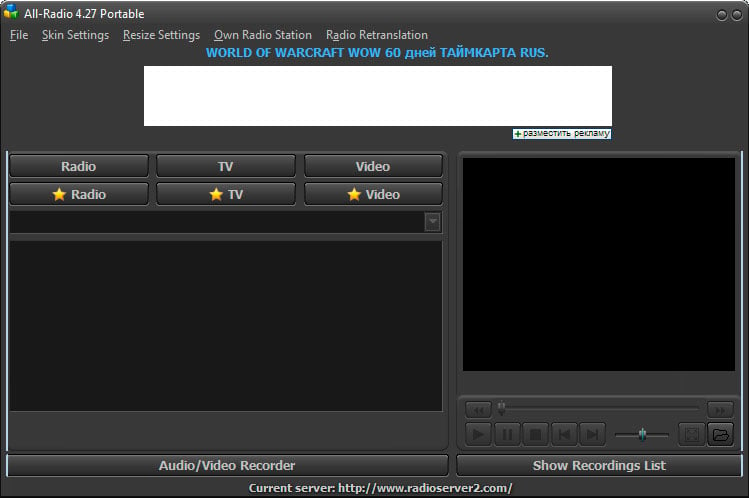
All-Radio 4.27 Portable Can't Be Removed? Then Your PC Is Severely Infected (bleepingcomputer.com) 247

CaptainDork shares a report from Bleeping Computer: Starting yesterday, there have been numerous reports of people's Windows computers being infected with something called "All-Radio 4.27 Portable." After researching this heavily today, it has been determined that seeing this program is a symptom of a much bigger problem on your computer. If your computer is suddenly displaying the above program, then your computer is infected with malware that installs rootkits, miners, information-stealing Trojans, and a program that is using your computer to send send out spam.

Unfortunately, while some security programs are able to remove parts of the infection, the rootkit component needs manual removal help. Due to this, if you are infected with this malware, I strongly suggest that you create a malware removal help topic in our Virus Removal forum in order to receive one-on-one help in cleaning your computer. Some of the VirusTotal scans associated with this infection have also indicated that an information stealing Trojan could have been installed by this malware bundle as well. Therefore, it is strongly suggested that you change your passwords using a clean machine if you had logged into any accounts while infected.
6/29/18: The story has been updated to specify that this malware campaign is targeting Windows computers.
AI

MIT's AI Uses Radio Signals To See People Through Walls (inverse.com) 76

Researchers at the Massachusetts Institute of Technology have developed a new piece of software that uses wifi signals to monitor the movements, breathing, and heartbeats of humans on the other side of walls. While the researchers say this new tech could be used in areas like remote healthcare, it could in theory be used in more dystopian applications. Inverse reports: "We actually are tracking 14 different joints on the body [...] the head, the neck, the shoulders, the elbows, the wrists, the hips, the knees, and the feet," Dina Katabi, an electrical engineering and computer science teacher at MIT, said. "So you can get the full stick-figure that is dynamically moving with the individuals that are obstructed from you -- and that's something new that was not possible before." The technology works a little bit like radar, but to teach their neural network how to interpret these granular bits of human activity, the team at MIT's Computer Science and Artificial Intelligence Laboratory (CSAIL) had to create two separate A.I.s: a student and a teacher.

[T]he team developed one A.I. program that monitored human movements with a camera, on one side of a wall, and fed that information to their wifi X-ray A.I., called RF-Pose, as it struggled to make sense of the radio waves passing through that wall on the other side. The research builds off of a longstanding project at CSAIL lead by Katabi, which hopes to use this wifi tracking to help passively monitor the elderly and automate any emergency alerts to EMTs and medical professionals if they were to fall or suffer some other injury.
For more information, a press release and video about the software are available.
United Kingdom

FM Radio Faces UK Government Switch-Off As Digital Listening Passes 50 Percent Milestone (inews.co.uk) 99

The Amazon Echo and other smart speakers have helped push the audience for digital radio past that of FM and AM in the UK for the first time. According to Radio Joint Audience Research (RAJAR), digital listening has reached a new record share of 50.9%, up from 47.2% a year ago. This milestone will trigger a government review into whether the analog FM radio signal should be switched off altogether. iNews reports: The BBC said it would be "premature" to switch off the FM signal. It could cut off drivers with analogue car radios and disenfranchise older wireless listeners. Margot James, Digital minister, welcomed "an important milestone for radio." She confirmed that the Government will "work closely with all partners -- the BBC, commercial radio, (transmitter business) Arqiva, car manufacturers and listeners" before committing to a timetable for analogue switch-off.

James Purnell, BBC Director of Radio and Education, said: "We're fully committed to digital, and growing its audiences, but, along with other broadcasters, we've already said that it would be premature to switch off FM." Mr Purnell said that BBC podcast listening was up a third across all audiences since the same time last year, accounting now for 40,000 hours a week. But younger audiences have not inherited the habit of listening to "live" radio, even on digital.

Communications

Old AM Broadcast Towers Get a New Life 126

Esther Schindler shares an article from Hewlett Packard Enterprise: Video may have killed the radio star, but other media certainly make old AM radio towers superfluous... maybe. "As once-loyal listeners tune away, most AM stations are barely holding onto life, slashing staff and budgets as deeply as they can while struggling to find a return to profitability," reports HPE. "Once upon a time, having a broadcast license of any kind was like having a permit to print money. In today's world, that's no longer true." But, with some 10,000 AM broadcast towers in the United States stretching high into the sky, there may be an opportunity for wireless carriers who don't want to argue with community opposition from neighborhoods where residents don't want yet another cell tower. The amount of money an AM station owner can pocket by sharing its tower with a wireless partner varies widely, depending on the tower's location, height, and several other factors. But it's certainly more income -- and a way to keep "old" technology from becoming obsolete. "Using an AM tower, which has very often been in place for many years, avoids many zoning and other permitting issues, versus going in and creating a new site for a tower," Behr explains. He says local residents, businesses, and officials rarely complain about an AM broadcast tower that suddenly begins serving as a cell site. "That tower was there before they were, and it doesn't bother them," Lawrence Behr, CEO of Greenville, North Carolina-based LBA Group, says. "Hanging a few things on it is rarely controversial, so that's a real good thing for AMs."
United States

Emergency Alert Systems Used Across the US Can Be Easily Hijacked (helpnetsecurity.com) 44

A vulnerability affecting emergency alert systems supplied by ATI Systems, one of the leading suppliers of warning sirens in the USA, could be exploited remotely via radio frequencies to activate all the sirens and trigger false alarms. From a report: "We first found the vulnerability in San Francisco, and confirmed it in two other US locations including Sedgwick County, Wichita, Kansas," Balint Seeber, Director of Threat Research at Bastille, told Help Net Security. "Although we have not visited other locations to confirm the presence of the vulnerability, ATI Systems has customers in the US and overseas from the military, local government, educational and energy sectors.

"ATI features customers on its website around the US including One World Trade Center, WestPoint Military Academy and Entergy Nuclear Indian Point which are all in New York State, UMASS Amherst in Massachusetts, Eastern Arizona College, University of South Carolina and Eglin Air Force Base in Florida, amongst others." The vulnerability stems from the fact that the radio protocol used to control the sirens is not secure: activation commands are sent "in the clear," i.e. no encryption is used.

Businesses

Largest US Radio Company iHeartMedia Files For Bankruptcy (reuters.com) 159

The largest U.S. radio station owner, iHeartMedia, has filed for Chapter 11 bankruptcy as it "struggles with $20 billion in debt and falling revenue at its 858 radio stations," reports Reuters. The company has reportedly reached an agreement with holders of more than $10 billion of its outstanding debt for a balance sheet restructuring, which will reduce its debt by more than $10 billion. From the report: Cash on hand and cash generated from ongoing operations will be sufficient to fund the business during the bankruptcy process, said iHeartMedia, which owns Z100 in New York and Real 103.5 KISS FM in Chicago. The filing comes after John Malone's Liberty Media Corp proposed on Feb. 26 a deal to buy a 40 percent stake in a restructured iHeartMedia for $1.16 billion, uniting the company with Liberty's Sirius XM Holdings Inc satellite radio service. Clear Channel Outdoor Holdings Inc, a subsidiary of iHeartMedia, and its units did not commence Chapter 11 proceedings. The company had 14,300 employees at the end of 2016, according to its most recent annual report.
Sci-Fi

The Hitchhikers Guide To the Galaxy Returns With the Original Cast (arstechnica.com) 84

Jonathan M. Gitlin reports via Ars Technica: The Hitchhiker's Guide to the Galaxy deserves a special place in the geek pantheon. It's the story of hapless BBC radio editor Arthur Dent, his best friend Ford Prefect, and the adventures that result when Prefect saves Dent when the Earth is unexpectedly destroyed to make way for a galactic bypass. Written by the late, great Douglas Adams, THGTTG first appeared as a radio series in the UK back in 1978. On Thursday -- exactly 40 years to the day from that first broadcast -- it made its return home with the start of Hexagonal Phase, a radio dramatization of the sixth and final book of an increasingly misnamed trilogy.

Although Adams died suddenly and unexpectedly in 2001, the universe he gave birth to lived on. Beginning in 2004, the original radio cast was reunited to dramatize the third, fourth, and fifth books. In 2005, a film adaptation was released, and then in 2009 came a final novel in the "trilogy," And Another Thing..., written by the novelist Eoin Colfer. It's this story that the BBC is now dramatizing, again using many of the original cast, along with newcomers like Jim Broadbent, Lenny Henry, and Stephen Hawking. Yes, that Stephen Hawking.

Cellphones

NIH Study Links Cellphone Radiation To Cancer In Male Rats (techcrunch.com) 130

An anonymous reader quotes a report from TechCrunch: New studies from the National Institutes of Health -- specifically the National Toxicology Program -- find that cell phone radiation is potentially linked with certain forms of cancer, but they're far from conclusive. The results are complex and the studies have yet to be peer-reviewed, but some of the findings are clearly important enough to warrant public discussion. An early, partial version of this study teasing these effects appeared in 2016, but these are the full (draft) reports complete with data. Both papers note that "studies published to date have not demonstrated consistently increased incidences of tumors at any site associate with exposure to cell phone RFR [radio frequency radiation] in rats or mice." But the researchers felt that "based on the designs of the existing studies, it is difficult to definitively conclude that these negative results clearly indicate that cell phone RFR is not carcinogenic."

The studies exposed mice and rats to both 900 MHz and 1900 Mhz wavelength radio waves (each frequency being its own experiment) for about 9 hours per day, at various strengths ranging from 1 to 10 watts per kilogram. For comparison, the general limit the FCC imposes for exposure is 0.08 W/kg; the absolute maximum allowed, for the extremities of people with occupational exposures, is 20 W/kg for no longer than 6 minutes. So they were really blasting these mice. The rodents were examined for various health effects after various durations, from 28 days to 2 years. At 1900 MHz: Equivocal evidence of carcinogenicity in lung, liver and other organ tissues in both male and female mice.

Cellphones

Future Samsung Phones Will Have a Working FM Radio Chip (androidpolice.com) 215

A few months ago, LG announced a partnership with NextRadio to unlock the FM chip in its smartphones. Now, Samsung is doing the same. Android Police reports: NextRadio made the announcement, rightly explaining that FM radio is essential in areas with low connectivity and in emergency and disaster situations where a connection might be difficult to obtain or maintain and where access to information could be a matter of life and death. With the chip unlocked, users will be able to listen to local radio on their phone using the NextRadio Android app. The press release mentions that "upcoming [Samsung] smartphone models in the U.S. and Canada" will have the FM chip unlocked, however I did find several existing Samsung devices with their FM chip enabled on NextRadio's site.
Communications

Norway Becomes First Country To Switch Off FM Radio (thelocal.no) 183

An anonymous reader quotes a report from The Local Norway: Norway on Wednesday completed its transition to digital radio, becoming the first country in the world to shut down national broadcasts of its FM radio network despite some grumblings. As scheduled, the country's most northern regions and the Svalbard archipelago in the Arctic switched to Digital Audio Broadcasting (DAB) in the late morning, said Digitalradio Norge (DRN) which groups Norway's public and commercial radio. The transition, which began on January 11th, allows for better sound quality, a greater number of channels and more functions, all at a cost eight times lower than FM radio, according to authorities. The move has however been met with some criticism linked to technical incidents and claims that there is not sufficient DAB coverage across the country. In addition, radio users have complained about the cost of having to buy new receivers or adapters, usually priced around 100 to 200 euros. Currently, fewer than half of motorists (49 percent) are able to listen to DAB in their cars, according to DRN figures. According to a study cited by local media, the share of Norwegians who listen to the radio on a daily basis has dropped by 10 percent in one year, and public broadcaster NRK has lost 21 percent of its audience.
Businesses

FCC Repeals Decades-Old Rules Blocking Broadcast Media Mergers (variety.com) 146

An anonymous reader quotes a report from The Washington Post (Warning: source may be paywalled; alternative source): Federal regulators rolled back decades-old rules on Thursday, making it far easier for media outlets to be bought and sold -- potentially leading to more newspapers, radio stations and television broadcasters being owned by a handful of companies. The regulations, eliminated in a 3-to-2 vote by the Federal Communications Commission, were first put in place in the 1970s to ensure that a diversity of voices and opinions could be heard on the air or in print. But now those rules represent a threat to small outlets that are struggling to survive in a vastly different media world, according to FCC Chairman Ajit Pai. One long-standing rule repealed Thursday prevented one company in a given media market from owning both a daily newspaper and a TV station. Another rule blocked TV stations in the same market from merging with each other if the combination would leave fewer than eight independently owned stations. The agency also took aim at rules restricting the number of TV and radio stations that any media company could simultaneously own in a single market. A major beneficiary of the deregulatory moves, analysts say, is Sinclair, a conservative broadcasting company that is seeking to buy up Tribune Media for $3.9 billion.
Television

FCC To Loosen TV, Newspaper Ownership Rules (reuters.com) 86

The FCC is planning to vote on rolling back landmark media ownership regulations that prohibit owning a television station and newspaper in the same market and making it easier to acquire additional TV or radio stations. Reuters reports: If approved at the FCC's November meeting, the move would be a win for newspapers and broadcasters that have pushed for the change for decades, but was criticized by Democrats who said it could usher in a new era of media consolidation. The FCC in 1975 banned cross-ownership of a newspaper and broadcast station in the same market, unless it granted a waiver, to ensure a diversity of opinions. The rule was made before the explosion of internet and cable news and Republican President Donald Trump and Pai have vowed to reduce government regulation.

"We must stop the federal government from intervening in the news business," Pai told a congressional panel, noting that many newspapers have closed and many radio and TV stations are struggling. Pai moved earlier this year to make it easier for some companies to own a larger number of local stations. Pai said the marketplace no longer justifies the rules, citing Facebook and Alphabet's dominance of internet advertising. "Online competition for the collection and distribution of news is greater than ever. And just two internet companies claim 100 percent of recent online advertising growth; indeed, their digital ad revenue this year alone will be greater than the market cap of the entire broadcasting industry," Pai said.

Television

FCC Ends Decades-Old Rule Designed To Keep TV, Radio Under Local Control (variety.com) 223

The FCC on Tuesday voted to eliminate a rule that required broadcast station groups to maintain a physical presence in the community of their primary local coverage area, a move that critics say will help media companies further consolidate their operations and even be a boost to the ambitions of Sinclair Broadcast Group. Variety reports: But FCC Chairman Ajit Pai said the elimination of the rule has been a long time coming and will produce cost savings for stations. He said the "overwhelming majority" of public input favored the elimination of the rule, citing the support for such an action even from National Public Radio. "Continuing to require a main studio would detract from, rather than promote, a broadcaster's ability and incentive to keep people informed and serve the public interest," Pai said. The National Association of Broadcasters supports the rule's elimination, and has argued that it will free up funds for stations to spend on staff and programming. Commissioner Michael O'Rielly said the elimination reflects how the public currently interacts with local businesses -- not by visiting their facilities, but through telecommunications and social media. The rule dates to 1940. The two Democrats on the commission opposed the change. "There are many broadcasters who do an extraordinary job serving communities during disaster," said FCC Commissioner Jessica Rosenworcel. "But let's be honest -- they can only do so when they have a real presence in their area of license. That's not a retrograde notion -- it's a fact."
Communications

FCC Silenced Puerto Rico Radio Station's Boosters In March 2017 155

An dochasac writes: WAPA (680 AM) is a radio station in San Juan, Puerto Rico. After Hurricane Maria took out power, phone lines, cell towers and internet, WAPA was the only Puerto Rican radio station on the air for crucial public emergency communication. But WAPA's signal coverage was significantly cut in March 2017 when the FCC refused to renew the license for synchronous AM booster stations at Arecibo, Mayaguez and Aguadilla in March due to procedural issues with the petition for renewal. This decision limited the coverage, signal strength and signal quality of this station for remote and mountainous parts of Puerto Rico where the need for emergency communications is greatest. The FCC audio division chief who pulled WAPA's synchronous booster license decided to retire a few days ago. The position is open but is focused on legal training rather than technical expertise and experience with emergency communications.

FCC audio division's regulations have done little to stop AM and satellite radio from broadcasting right-wing streams-of-consciousness throughout the lower 48 states. With IoT, cellular, mesh, satellite, social media and cognitive radio, communications technology is changing much faster than the FCC's legal efforts to regulate it. But its arcane regulations leave Puerto Rico as one of the few islands in the Caribbean without a long distance shortwave broadcast station. With line of sight FM stations offline and WAPA's AM station neutered, post-Maria Puerto Ricans have a better chance of getting news and emergency information from Havana, Cuba than from anything under the FCC's increasingly pointless jurisdiction.
Communications

Air Force Gives 10-Year-Old Orbiting Satellite To Ham Radio Operators (arrl.org) 74

Longtime Slashdot reader Bruce Perens writes: The U.S. Air Force has transferred control of a 10-year-old orbiting satellite to AMSAT, a ham radio organization, which has enabled it for any licensed ham to use on the air, as the satellite's Air Force missions have ended. Falconsat 3's first mission was science: measuring gravity gradient, spectrometry of the plasmasphere, electronic noise in the plasmasphere, and testing three-axis attitude control using microthrusters. Secondarily it was used to train Air Force Institute of Technology students in space operations, with close to 700 cadets obtaining ham licenses in order to operate a number of Air Force satellites using ham frequencies.

Now in its third mission, control of the satellite has been transferred to AMSAT, the Radio Amateur Satellite Corporation, and all government frequencies have been disabled with only ham ones remaining. The satellite will relay APRS (position and status reporting) signals, it will operate a BBS in the sky, and will broadcast telemetry.

Communications

FCC Chief Tells Apple To Turn on iPhone's FM Radio Chip (cnet.com) 235

FCC Chairman Ajit Pai pushed Apple on Friday to activate the FM radio chips in the iPhone. From a report: In the wake of three major hurricanes that have wiped out communications for millions of people over the past month, Pai issued a statement urging Apple, one of the largest makers of cellphones in the US, to "reconsider its position, given the devastation wrought by Hurricanes Harvey, Irma, and Maria." FM radios that are already included in every phone could be used to access "life-saving information" during disasters, he said. For years the majority of smartphones sold in the US have included FM radios, but most of them have been turned off so that you couldn't use the function. Why? Mobile customers would be a lot less likely to subscribe to streaming music services if they could just listen to traditional, free broadcast radio. This incentive is especially true for Apple, which has a streaming music service. Apple said in a statement: "iPhone 7 and iPhone 8 models do not have FM radio chips in them nor do they have antennas designed to support FM signals, so it is not possible to enable FM reception in these products."
Communications

Red Cross Asks For 50 Ham Radio Operators To Fly To Puerto Rico (arrl.org) 121

Bruce Perens writes: The red cross has asked for 50 ham radio operators to fly to Puerto Rico and be deployed there for up to three weeks. This is unprecedented in the 75-year cooperation between Red Cross and ARRL, the national organization of ham radio operators for the U.S. The operators will relay health-and-welfare messages and provide communications links where those are missing and are essential to rescue and recovery. With much infrastructure destroyed, short-wave radio is a critical means of communicating from Puerto Rico to the Mainland at this time.
Music

Traditional Radio Faces a Grim Future, New Study Says (variety.com) 240

In a 30-page report, Larry Miller, the head of New York University's Steinhart Music Business Program, argues that traditional radio has failed to engage with Generation Z -- people born after 1995 -- and that its influence and relevance will continue to be subsumed by digital services unless it upgrades. Key points made in the study include: Generation Z, which is projected to account for 40% of all consumers in the U.S. by 2020, shows little interest in traditional media, including radio, having grown up in an on-demand digital environment. AM/FM radio is in the midst of a massive drop-off as a music-discovery tool by younger generations, with self-reported listening to AM/FM radio among teens aged 13 and up declining by almost 50 percentage points between 2005 and 2016. Music discovery as a whole is moving away from AM/FM radio and toward YouTube, Spotify and Pandora, especially among younger listeners, with 19% of a 2017 study of surveyed listeners citing it as a source for keeping up-to-date with music -- down from 28% the previous year. Among 12-24 year olds who find music discovery important, AM/FM radio (50%) becomes even less influential, trailing YouTube (80%), Spotify (59%), and Pandora (53%). By 2020, 75% of new cars are expected to be "connected" to digital services, breaking radio's monopoly on the car dashboard and relegating AM/FM to just one of a series of audio options behind the wheel. According to the U.S. Department of Transportation, the typical car in the U.S. was 11.6 years old in 2016, which explains why radio has not yet faced its disruption event. However, drivers are buying new cars at a faster rate than ever, and new vehicles come with more installed options for digital music services.
Communications

Guam Radio Stations Accidentally Conduct Emergency Alert Amid North Korea Threat (theguardian.com) 50

the_webmaestro writes: A couple of radio stations in Guam conducted an unscheduled test of the Emergency Alert Broadcast System, sending some residents -- already on edge due to the back and forth between the North Korean regime and the tweets made by the President of the United States -- into a panic. From the Guam Homeland Security/Office of Civil Defense Facebook page: "The Offices of Guam Homeland Security and Civil Defense (GHS/OCD), in conjunction with the Mariana Regional Fusion Center (MRFC), our federal and military partners, continue to monitor the recent events surrounding North Korea and their threatening actions. Residents and visitors may have noticed at 12:25 a.m., an unscheduled test of the Emergency Alert Broadcast System (EAS) was triggered from KTWG/KSTO AM. The message read: 'A BROADCAST STATION OR CABLE SYSTEM HAS ISSUED A CIVIL DANGER WARNING FOR THE FOLLOWING COUNTIES/AREAS: Guam, Guam; AT 12:25 AM ON AUG 15, 2017 EFFECTIVE UNTIL 12:40 AM. MESSAGE FROM KTWGKSTO.' The unauthorized test was NOT connected to any emergency, threat or warning. GHS/OCD has worked with KSTO to ensure the human error will not occur again. There is no scheduled test of the EAS or All Hazards Alert Warning System sirens today."

In addition, the Guam Power Authority (GPA) reported there were two scheduled outages, for emergency interruption of power, at 2:30 p.m. and 7 p.m., August 14: "Unrelated to the EAS unauthorized test, the Guam Power Authority (GPA) reported there were two scheduled outages, for emergency interruption of power, at 2:30 p.m. and 7 p.m., August 14 for customers located in Talofofo located along along Rte.17, Chalan J. Kindo, Vicente Borja Dr., Felix Dydasco St., Henry Simpson area to bus shelter by Bishop Street and other customers in these locations."

Communications

The Ghostly Radio Station That No One Claims To Run (bbc.com) 127

Zaria Gorvett, writing for BBC: In the middle of a Russian swampland, not far from the city of St Petersburg, is a rectangular iron gate. Beyond its rusted bars is a collection of radio towers, abandoned buildings and power lines bordered by a dry-stone wall. This sinister location is the focus of a mystery which stretches back to the height of the Cold War. It is thought to be the headquarters of a radio station, "MDZhB", that no-one has ever claimed to run. Twenty-four hours a day, seven days a week, for the last three-and-a-half decades, it's been broadcasting a dull, monotonous tone. Every few seconds it's joined by a second sound, like some ghostly ship sounding its foghorn. Then the drone continues. Once or twice a week, a man or woman will read out some words in Russian, such as "dinghy" or "farming specialist". And that's it. Anyone, anywhere in the world can listen in, simply by tuning a radio to the frequency 4625 kHz. It's so enigmatic, it's as if it was designed with conspiracy theorists in mind. Today the station has an online following numbering in the tens of thousands, who know it affectionately as "the Buzzer." It joins two similar mystery stations, "the Pip" and the "Squeaky Wheel." As their fans readily admit themselves, they have absolutely no idea what they are listening to.

Slashdot Top Deals